Key takeaways
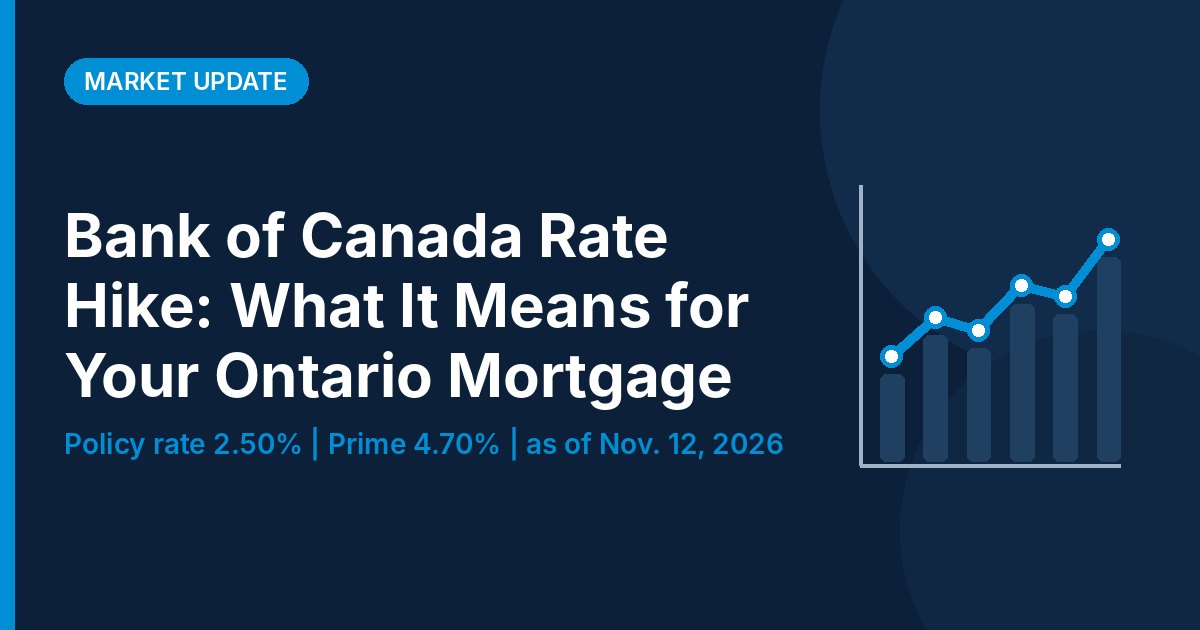
- The Bank of Canada raised its policy rate to 2.50% on October 28, 2026, its first increase since July 2023.
- Big-bank prime rates rose from 4.45% to 4.70% on October 29, which affects most variable-rate mortgages and HELOCs.
- Fixed rates follow bond yields, which have moved up and down in early November.
- GTA home sales fell 7.9% year over year in October, while prices were lower than a year ago (TRREB).
- The next Bank of Canada decision is December 9, 2026. Renewing within six months? It is a good time to compare options.
On October 28, 2026, the Bank of Canada raised its policy rate by 0.25 percentage points to 2.50%, its first increase since July 2023. Canada's big banks followed the next day, lifting their prime rates from 4.45% to 4.70%.
If you have a variable-rate mortgage or a home equity line of credit, or you are renewing or buying in the next few months, here is what changed, what did not, and what to watch before the Bank's next announcement on December 9, 2026. Figures are as of November 12, 2026.
What did the Bank of Canada announce on October 28?
The Bank increased its target for the overnight rate to 2.50%, with the Bank Rate at 2.75% and the deposit rate at 2.45%. It was the first move in a year: the rate had held at 2.25% since October 2025.
The Bank also said it could need to raise the policy rate further, but that given the uncertainty it would proceed carefully. In plain terms, it did not promise more increases, and it did not rule them out.
| Benchmark | Before | After | Source and date |
|---|---|---|---|
| Bank of Canada policy rate | 2.25% | 2.50% | Bank of Canada, Oct. 28, 2026 |
| Big-bank prime rate | 4.45% | 4.70% | Bank announcements, effective Oct. 29, 2026 |
| 5-year Government of Canada bond yield | About 3.50% (Nov. 3) | About 3.46% (Nov. 9) | Canadian Mortgage Trends, Nov. 10, 2026 |
Why did the Bank raise rates now?
The short answer is inflation tied to energy prices. According to the Bank, consumer price inflation has been around 3% since April and is expected to reach about 3.5% by the end of 2026, largely because oil prices have stayed high during the conflict in the Middle East. Inflation excluding gasoline was 2.2% in September.
The Bank's concern is that high fuel costs start showing up in the price of almost everything else, because they raise the cost of producing and shipping goods. It now projects inflation to average about 3% in 2027 before returning to its 2% target around the middle of 2028. The hike is meant to reduce the risk that higher prices become more widespread.
At the same time, the Bank noted that growth picked up this year and that it expects housing to stay relatively weak. That mix is why this decision feels different from the rapid increases of 2022 and 2023.
What does the hike mean for variable-rate mortgages and HELOCs?
Most variable-rate mortgages and home equity lines of credit are priced as prime plus or minus a set amount. When prime rose by 0.25 percentage points on October 29, so did the rate on most of these products.
- Adjustable payments: your regular payment usually goes up right away.
- Fixed payments on a variable rate: your payment may stay the same, but more of it goes to interest and less to principal, so it can take longer to pay off.
- HELOCs: the interest charged on your balance rises with prime.
Here is a hypothetical example, not a rate offer, OAC: on a $500,000 mortgage with a 25-year amortization, a rate change from 4.00% to 4.25% moves the monthly payment from about $2,630 to $2,698, roughly $68 more per month (calculated with semi-annual compounding). Your own numbers depend on your balance, amortization and lender terms. You can try different scenarios with the mortgage calculators.
Are fixed mortgage rates going up too?
Not directly. Fixed rates are mostly priced off Government of Canada bond yields rather than the Bank of Canada's policy rate. Those yields had already risen through the fall on inflation worries, so much of the effect showed up in fixed rates before the October decision.
Bond yields have also been moving around. Canadian Mortgage Trends reported that the 5-year yield fell from about 3.50% on November 3 to about 3.38% by November 6, then jumped back toward 3.46% after a stronger-than-expected U.S. inflation report. Fixed rates offered by lenders can shift week to week when yields move like this.
Fixed and variable each have trade-offs. A fixed rate gives you payment certainty for the term. A variable rate moves with prime, which can work for or against you, and usually comes with lower penalties if you break the mortgage early. Which one suits you depends on your budget, how long you plan to stay and how comfortable you are with change, so it is worth reviewing both rather than assuming one is better.
What does this mean for my mortgage renewal?
If your term ends in the next six months, the main lesson is to start early. Many lenders will hold a rate for around 120 days, which can protect you if rates rise while you compare. If rates fall instead, some lenders will adjust to the lower rate before you close.
Homeowners renewing from the very low rates of 2020 and 2021 may see a noticeable payment change at renewal. Looking at your options ahead of time, including your amortization, payment frequency and whether you want to use home equity, gives you room to plan. My mortgage renewals page explains how switching lenders at maturity works.
What does it mean for buyers in Mississauga, Brampton and the GTA?
The local market has been cooling. According to the Toronto Regional Real Estate Board, GTA home sales in October 2026 were 5,603, down 7.9% from a year earlier, while new listings fell 11.9% to 14,173. The MLS® Home Price Index composite benchmark was down 4.3% year over year, and the average selling price was $1,024,108, down 2.7%.
TRREB noted that while borrowing costs have increased, lower prices have offset much of the effect on monthly payments. On a seasonally adjusted basis, sales and new listings were up from September.
For buyers, the practical step is a mortgage pre-approval with a rate hold. Remember that you still need to qualify at the stress test rate, so a small rate change can affect how much you can borrow. If this is your first home, my first-time home buyers guide covers the programs and costs to plan for.
What could happen on December 9?
No one knows for certain. In the Bank of Canada's latest Market Participants Survey, conducted before the October decision and released November 9, the median respondent expected the policy rate to reach 2.75% by March 2027 and stay there through 2028. That is a forecast from financial market participants, not a commitment from the Bank, and forecasts change as new inflation and jobs data come in.
Whatever happens, here is a simple checklist to work through before December 9:
- Find out whether your mortgage or HELOC is variable, and whether your payment is adjustable or fixed.
- Check your maturity date and note when you are 120 days out.
- Review your monthly budget for room if prime rises again.
- If you are buying, get pre-approved and ask about a rate hold.
- If you are thinking of locking in from variable to fixed, ask your lender about the terms and compare the options first.
Frequently asked questions
What is the prime rate in Canada now?
Will my variable mortgage payment go up?
Does the Bank of Canada hike change fixed mortgage rates?
When is the next Bank of Canada announcement?
Can you help if I live outside Mississauga?
Sources
- Bank of Canada raises the policy rate by 25 basis points to 2½% – Bank of Canada, October 28, 2026
- Major banks raise prime rates following Bank of Canada's 1st hike in three years – The Canadian Press (via Castanet), October 28, 2026
- 5-year bond yield jumps after U.S. inflation report – Canadian Mortgage Trends, November 10, 2026
- Market Watch, October 2026 – Toronto Regional Real Estate Board, November 1, 2026
- Market Participants Survey, Third Quarter of 2026 – Bank of Canada, November 9, 2026

Sanmeet Singh
I am licensed in Ontario and help buyers and homeowners anywhere in the province, from my Mississauga office or by phone and video, in English, Hindi and Punjabi. More about me →